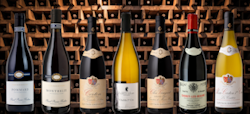
Grès de Gayanne

Scoprite il Gres de Gayanne, vino rosso Côtes du Rhône: un vino che incarna la ricchezza e la diversità dei terroir della regione, regalando un'esperienza gustativa indimenticabile.

Il vino rosso Côtes du Rhône "Le Gres de Gayanne" è la scelta ideale per chi cerca un vino ricco e complesso, perfetto per accompagnare i pasti o i momenti di convivialità.

Proveniente dai migliori vigneti della regione, questo vino si distingue per i suoi aromi di frutti rossi maturi e le sue note speziate, offrendo una struttura importante e un finale persistente. Che siate esperti o neofiti, saprà conquistare il vostro palato.


Grès de Gayanne Vin Rouge, Côtes du Rhône

Grès de Gayanne Red Wine, Côtes du Rhône
P646003
2024
    Tempi di consegna:48.00
Aggiungere al carrello

Scopri il vino rosso Côtes du Rhône Gres de Gayanne, un vino che incarna l'autenticità e la ricchezza dei terroir del Rodano, perfetto per i tuoi momenti di convivialità.

Grès de Gayanne Vin Rouge, Côtes du Rhône

Scoprite il Gres de Gayanne, un vino rosso Côtes du Rhône-Villages ricco di sapori, capace di conquistare i vostri ospiti durante i pasti.

Grazie ai suoi aromi di frutti rossi e spezie, si abbina perfettamente a carni e formaggi, donando un tocco caloroso ai vostri momenti di convivialità.

  • Specificazioni
  • Prodotti collegati
MAISON:

The producer of the wine "Grès de Gayanne" is the merchant and winemaking firm Noël Briday, a brand belonging to the family-owned group Vins Richard (Domaines Richard).


The producer’s identity

• Noël Briday: This is the wine-sourcing and merchant division of the Richard group, historically based in Corcelles-en-Beaujolais. It selects, blends, and ages wines from several French wine regions (Beaujolais, Mâconnais, and the Rhône Valley).


• The Richard Family: Founded in 1892, this French family-owned firm is a major player in the distribution of wine to the hospitality sector—specifically cafés, hotels, and restaurants (CHR).


• Domaines Richard: Alongside its merchant operations, the family owns over 420 hectares of vineyards spread across the Rhône Valley, Beaujolais, and Bordeaux.

REGION:

Le Grès de Gayanne comes from the Rhône Valley wine region (specifically its southern part), in southeastern France.

SOUS-REGION:

The Grès de Gayanne wine sub-region is located in the Southern Rhône Valley (also known as the Southern Rhône), which makes up the southern half of the Rhône Valley wine region.

APPELLATION:

The Grès de Gayanne designation falls under the Côtes du Rhône AOP (Protected Designation of Origin) and is further complemented by organic farming (AB) certification.

CEPAGE:

The grape varieties in Grès de Gayanne are Grenache (the dominant variety) and Syrah (with a small proportion of Carignan sometimes included, depending on the vintage).

Role of each grape variety in the blend:

• Grenache (the primary variety): This forms the foundation of the wine. It provides generosity, roundness, and alcohol content (14%), as well as luscious aromas of ripe red fruits (cherry, raspberry) and sweet spices.
• Syrah (the complementary variety): This balances the richness of the Grenache by contributing a deeper color, a silky tannic structure, a pleasant freshness, and notes of black fruits (blackcurrant, blackberry) and black pepper.

VITICULIURE:

Viticulture at Grès de Gayanne is certified organic (Agriculture Biologique), with vineyard management focused on respecting the soil and allowing the natural expression of the Mediterranean terroir.

The vineyard is cultivated without the use of synthetic pesticides or chemical fertilizers, favoring natural treatments (such as sulfur and copper in limited quantities) and mechanical soil cultivation.

COULEUR:

Le Grès de Gayanne is a red wine, displaying a deep ruby-red color with garnet or purplish highlights in its youth.

ALCOOL:

The alcohol content of Grès de Gayanne is 14% vol. (which may vary slightly, ranging from 13.5% to 14.5% depending on the vintage).

CONSEIL DE SERVICE:

To fully appreciate Grès de Gayanne, serve it slightly chilled—between 14°C and 16°C—after allowing it to breathe for about 30 minutes.

Key steps for serving:

• Ideal temperature (14°C–16°C). With an alcohol content of 14% and a Grenache-dominant blend, it should not be served too warm (at a typical room temperature of 20°C, the alcohol would overpower the fruit). If the bottle has been stored at room temperature, place it in the refrigerator for about 20 to 30 minutes before serving.
• Aeration. Open the bottle 30 minutes before serving (or decant it briefly if the vintage is very young) to release the aromas of ripe fruit and soften the tannins from the Syrah.


• Choice of glass. Use a fairly large, tulip-shaped red wine glass (such as a Bordeaux-style or a versatile all-purpose glass) to concentrate the aromas of red fruit and spices.
• Storage after opening. Once resealed and placed in the refrigerator, the bottle will keep for 2 to 3 days (remember to take it out 20 minutes before serving it again).

TEMPS DE GARDE:

Grès de Gayanne has an aging potential of 3 to 5 years from its vintage year (for example, a 2022 or 2023 vintage is best enjoyed between now and 2026–2028).

Evolution and drinking window

• Drink young (1 to 3 years). In its early years, the wine fully expresses the freshness of its crisp red and black fruit aromas (cherry, raspberry, blackcurrant) and its delightful, supple character.
• At its peak (3 to 5 years). After a few years in the cellar, the tannins from the Syrah and Grenache soften further, and the profile evolves toward more integrated notes of sweet spices, stewed fruits, and *garrigue* (Mediterranean scrubland).


• Storage conditions. Store the bottle lying down, away from light and vibrations, in a cool place with a constant temperature (ideally between 11°C and 14°C).

ACCORDS METS RECOMMANDÉS:

Le Grès de Gayanne (an organic AOP Côtes du Rhône red) pairs ideally with grilled or roasted meats, Mediterranean-style cuisine seasoned with herbs, and aged hard cheeses.

Food and Wine Pairing Ideas

• Grilled and roasted meats: Lamb chops with Herbes de Provence, grilled ribeye or flank steak, marinated beef skewers, roast chicken with thyme, or pork tenderloin.
• Slow-cooked dishes and everyday meals: A light Provençal-style beef stew (*daube*), *boeuf bourguignon*, lasagna Bolognese, moussaka, or a lamb tagine with mild spices.
• Charcuterie and appetizer spreads: Country-style terrine, artisanal dry-cured sausage, aged dry-cured ham (such as Bayonne or Serrano), and hot tapas.
• Vegetarian options: Provençal vegetable *tian*, slow-cooked ratatouille, eggplant gratin with tomato and Parmesan, or sautéed mushrooms.
• Cheeses: Pressed cheeses—whether uncooked or cooked (such as Saint-Nectaire, medium-aged Cantal, sheep’s milk *tomme*, or young Comté)—as well as semi-dry goat cheeses.

What to Avoid

• Delicate fish or shellfish (the wine’s tannins would create a metallic bitterness).
• Highly spicy or chili-laden dishes (which would accentuate the sensation of the wine’s 14% alcohol content).

ALLERGENE:

May contain sulphites

Grès de Gayanne Côtes du Rhône