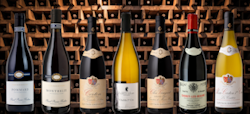
Domaine des Sénéchaux

Scoprite il Domaine des Sénéchaux Blanc Châteauneuf-du-Pape, un vino d'eccezione che unisce eleganza e complessità, ideale per accompagnare i vostri momenti più preziosi.

Il Domaine des Sénéchaux Blanc Châteauneuf-du-Pape è la scelta ideale per gli amanti dei vini raffinati. Questo vino offre un profilo aromatico ricco e complesso, con note floreali e di frutta matura che conquistano fin dal primo sorso.

Perfetto per accompagnare piatti a base di frutti di mare o pollame arrosto, questo vino si distingue per la sua freschezza ed equilibrio. Concedetevi un'esperienza sensoriale unica, capace di impreziosire i vostri pasti e le vostre occasioni di festa.


2010 Domaine des Sénéchaux Blanc AOC Châteauneuf-du-Pape

2010 Domaine des Sénéchaux AOC Châteauneuf-du-Pape Whi
P646006
    Tempi di consegna:48.00
Aggiungere al carrello
Scoprite il Domaine des Sénéchaux AOC Châteauneuf-du-Pape Blanc 2010, un vino d'eccezione che unisce eleganza e complessità per un'esperienza gustativa indimenticabile.

Il Domaine des Sénéchaux AOC Châteauneuf-du-Pape Blanc 2010 è un vino di una complessità notevole. I suoi aromi floreali e fruttati si uniscono a una struttura equilibrata.

Ideale per accompagnare piatti a base di frutti di mare o pollame, promette un'esperienza gustativa memorabile. Concedetevi questo vino eccezionale!

2010 Domaine des Sénéchaux AOC Châteauneuf-du-Pape White
  • Specificazioni
MAISON

The producer of Domaine des Sénéchaux is the JM Cazes family (owners of the renowned Bordeaux estates Château Lynch-Bages and Château Les Ormes de Pez), who acquired the property in 2006.

REGION:

This wine comes from the southern Rhône Valley, within the prestigious Châteauneuf-du-Pape AOC appellation (Vaucluse department, in the Provence-Alpes-Côte d'Azur region).

SOUS-REGION

The wine sub-region is the Southern Rhône Valley (or Southern Rhône).

APPELLATION:

The designation for this wine is the AOC Châteauneuf-du-Pape (Appellation d'Origine Contrôlée).

CEPAGE:

The blend for this 2010 vintage is based on four white grape varieties traditional to the appellation: 34% Roussanne, 29% Grenache Blanc, 29% Clairette, and 8% Bourboulenc.

The role of each grape variety in the wine:

• Roussanne (34%): The primary variety in this cuvée, it contributes aromatic complexity (notes of flowers, honey, apricot, and hazelnut), structure, and excellent aging potential.
• Grenache Blanc (29%): This variety lends the wine roundness, richness, a rich texture on the palate, and a lovely sense of fullness.
• Clairette (29%): It balances the richness of the Grenache by adding finesse, freshness, a floral touch, and a subtly mineral finish.
• Bourboulenc (8%): ​​A late-ripening variety native to the region, it rounds out the blend with a hint of lively acidity and citrus notes that bring vibrancy to the whole.

VITICULIURE

For this white cuvée, viticulture at Domaine des Sénéchaux is based on sustainable farming practices—certified as HVE (*Haute Valeur Environnementale*, or High Environmental Value)—and rigorous manual labor, as detailed in the official technical data sheet for the 2010 vintage.

COULEUR:

This wine is a white wine (specifically, a dry white wine).

Visual appearance (color/hue)

• In its youth: It displayed a brilliant pale yellow color with lemon and golden highlights.
• At maturity (today): After more than 15 years of aging, its color has naturally evolved into a deep golden yellow—or even a slight amber, depending on storage conditions—reflecting the richness of the Roussanne and Grenache Blanc grape varieties.

ALCOOL:

The alcoholic strength of this wine is 14% vol. (14 degrees of alcohol).

CONSEIL DE SERVICE

To fully enjoy a 2010 Domaine des Sénéchaux Blanc at its current stage of maturity (after more than 15 years of aging), serve it chilled—but never ice-cold—ideally between 12°C and 14°C (54°F–57°F).

Key steps for serving:

• Temperature: Avoid serving it too cold (below 10°C/50°F), as low temperatures will mask its complex tertiary aromas—such as honey, hazelnut, and dried fruit—and make its structure feel harsh. Conversely, if the temperature exceeds 15°C (59°F), the 14% alcohol content may become overly prominent.
• Opening and decanting: As this is a mature white wine, decanting is not recommended; sudden, intense exposure to oxygen could cause the wine to lose its vitality. Simply open the bottle 30 to 45 minutes before serving and allow the wine to open up gradually, directly in the glass.
• Glassware: Opt for a large, generous white wine glass—such as one designed for white Burgundy or a large, universal-style glass—to allow the aromas to flourish while maintaining balance on the palate.
• Serving precaution: Keep the bottle upright for a few hours before opening so that any natural sediment (such as tartrate crystals or color-related deposits that develop with age) can settle at the bottom.

TEMPS DE GARDE

The quality of the vintage. The year 2010 is considered exceptional in the southern Rhône Valley, offering a rare balance between aromatic concentration and preserved acidity.

ACCORDS METS RECOMMANDÉS

To pair with a 2010 Domaine des Sénéchaux Blanc at its current stage of development—characterized by notes of honey, dried fruits, and hazelnut, a full-bodied texture, and 14% alcohol—opt for rich, creamy, or mildly spiced gourmet dishes that can stand up to the wine’s power without being overwhelmed.

Food and Wine Pairing Suggestions

• Fine fish and shellfish:
• Pan-seared scallops with porcini mushrooms or a saffron cream sauce.
• Roasted lobster or spiny lobster with semi-salted butter.
• Turbot, monkfish, or wild sea bass served with a *beurre blanc* or hollandaise sauce.

• White meats and offal:
• Bresse chicken supreme with a cream and morel mushroom sauce.
• Veal escalope or loin with a cream and wild mushroom sauce.
• Braised or pan-seared veal sweetbreads.

• Aromatic and vegetarian dishes:
• Creamy risotto with wild mushrooms (chanterelles, porcini) or white truffles.
• Mildly spiced, mellow dishes (such as a chicken tagine with preserved lemons and almonds, or a mild shrimp curry with coconut milk).

• Cheeses:
• Well-aged, cooked, pressed-paste cheeses—such as mature Comté (aged 24–36 months), alpine Beaufort, or Swiss Gruyère—whose hazelnut and dried-fruit notes resonate perfectly with the wine’s evolved character.

What to Avoid

Steer clear of dishes that are overly acidic (such as those with vinaigrettes, sharp citrus, or raw tomatoes) or raw shellfish (like oysters), as these will accentuate the wine’s alcohol content and create an unpleasant, metallic imbalance on the palate.

ALLERGENE:

May contain sulphites

Domaine des Sénéchaux Châteauneuf-du-Pape Vallée du Rhône