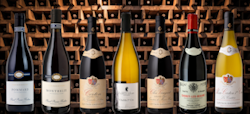
THE ESTATE
Domaine Capitain-Gagnerot is a historic, family-run wine estate founded in 1802, located in Ladoix-Serrigny, Burgundy. Today, the estate manages 16 hectares of its own vineyards and produces wines from 21 appellations across the Côte de Beaune and the Côte de Nuits.
Current Generation: Since 2019, the sixth generation has been at the helm of the estate. Pierre-François Capitain oversees the vineyards and the winemaking process, working alongside his sister, Delphine. REGION
Corton-Renardes Grand Cru is produced in the Burgundy wine region—specifically within the Côte de Beaune sub-region (in the Côte-d'Or department). APPELLATION
This wine falls under the Corton Grand Cru AOC, with the addition of the specific *climat* (vineyard site) name "Les Renardes," resulting in the official designation: Corton-Renardes Grand Cru. It sits at the very pinnacle of the Burgundy wine hierarchy. GRAPE VARIETY
Domaine Capitain-Gagnerot’s Corton-Renardes Grand Cru is crafted from 100% Pinot Noir—the quintessential grape variety for fine red Burgundies.
A demanding variety, Pinot Noir produces compact clusters of small, thin-skinned, blue-black berries. Highly sensitive to the climate and the nature of the subsoil, it acts as a precise indicator of the nuances found in each individual plot. VITICULTURE
Viticulture at Domaine Capitain-Gagnerot is based on certified organic farming, supplemented by practices inspired by biodynamics. Intervention is kept to a minimum to respect the natural balance of both the vine and the soil.
The vineyard has been officially certified organic by Ecocert since the 2021 vintage, with a strict ban on all synthetic pesticides, herbicides, and chemical fertilizers. COLOR
Domaine Capitain-Gagnerot’s Corton-Renardes Grand Cru is a red wine characterized by an intense, brilliant ruby-red hue [capitain-gagnerot.com]. ALCOHOL CONTENT
According to the estate’s official technical sheet, Domaine Capitain-Gagnerot’s Corton-Renardes Grand Cru has an average alcohol content of 13.5% vol. (13.5°) [capitain-gagnerot.com]. SERVING ADVICE
Domaine Capitain-Gagnerot’s Corton-Renardes Grand Cru should be served at an ideal temperature of 15°C [capitain-gagnerot.com]. Serving it at this specific temperature allows the full aromatic finesse of the Pinot Noir to emerge without weighing down its tannic structure. Preparation and Tasting Tips • Temperature: Keep the wine at around 15°C [capitain-gagnerot.com]—avoiding overly warm room temperatures—to preserve the freshness of its fruit and its overall balance.
• Aeration and Decanting: For a young vintage, open the bottle 1 to 2 hours before serving, or decant the wine to help soften the tannins. For a mature vintage—more than 10 years old—avoid vigorous decanting, which could exhaust its delicate tertiary aromas; simply open the bottle 30 minutes before serving.
• Glassware: Use large-bowled, Burgundy-style glasses (with a wide bowl that tapers toward the rim) to encourage oxygenation and concentrate the wine’s complex bouquet. AGING POTENTIAL
Domaine Capitain-Gagnerot’s Corton-Renardes Grand Cru has an excellent aging potential of 8 to 15 years from the harvest, easily extending beyond 20 years in great Burgundy vintages. Its tannic structure, derived from the clay-limestone soils of the Upper Oxfordian stage, ensures a harmonious evolution. [capitain-gagnerot.com] FOOD AND WINE PAIRING Domaine Capitain-Gagnerot’s Corton-Renardes Grand Cru pairs ideally with premium red meats, fine game, and aged cheeses. [capitain-gagnerot.com] Its powerful structure and wild, earthy notes call for flavorful yet refined gastronomic cuisine. Game and distinctive poultry • Game (fur and feather): The estate particularly recommends fine game—such as roasted venison loin, a lighter-style hare stew (*civet*), or partridge with cabbage—which resonate with the wine’s animal and spicy notes. [capitain-gagnerot.com] • Roasted poultry: Bresse hen with morel mushrooms, wild duck, or roasted pigeon served with a concentrated pan reduction (*jus court*) harmonize beautifully with the silky, "lace-like" texture of the Pinot Noir. [capitain-gagnerot.com] Red meats and slow-cooked dishes • Lamb. A seven-hour slow-cooked leg of lamb or a herb-crusted rack of lamb highlights the balance and lingering finish of this cuvée [capitain-gagnerot.com].
• Beef and Burgundian gastronomy. A beef tenderloin Rossini, an aged rib steak, or a traditional beef bourguignon simmered in red wine complement the tannic structure of a Corton.
Garnishes and cheeses • Mushrooms and truffles. Pan-seared porcini mushrooms, chanterelles, or black Burgundy truffles naturally enhance the forest-floor aromas of a mature wine.
• Distinctive cheeses. Opt for soft, washed-rind cheeses typical of the region—such as Époisses, Ami du Chambertin, or Langres—as well as a truffle-infused Brillat-Savarin or a Comté.highly refined [capitain-gagnerot.com].
Pairings to avoid • Fish and highly spiced dishes. Avoid iodine-rich fish (which can impart a metallic taste to the tannins), as well as dishes with strong chili heat, which would mask the aromatic subtlety of this Grand Cru. MEDIA Domaine Capitain-Gagnerot and its Corton-Renardes Grand Cru are frequently recognized in the specialized press, authoritative wine guides, and online wine communities. • La Revue du vin de France: The estate is featured in the *Guide Vert* (Green Guide) of *La Revue du vin de France*, which commends the generous style of its red wines and the high standards of its viticulture—notably, the estate does not purchase grapes from outside sources. • Le Guide Hachette des Vins: The estate’s various *cuvées* are regularly selected and reviewed by the tasting team at *Le Guide Hachette des Vins*. • Regional and national press: The estate’s activities and heritage also garner media coverage—for instance, the daily newspaper *Le Bien Public* featured a report on the estate’s discovery and subsequent sale of century-old miniature bottles (*mignonnettes*), and the estate has also been covered by *Le Figaro Vin*. ALLERGEN:
May contain sulfites |